


Inversions
Inversions
Analogue Fuzz Pedal
Couldn't load pickup availability
Inversions is our take on the famed Big Muff tone - but with a big twist.
Instead of the traditional NPN transistor stages, Inversions uses CMOS inverters to build up its gain stages - the same chip used in the Sunn Beta Lead. This gives the pedal a sound that lies somewhere between the traditional, fuzzy tone of the Big Muff and the thicker, angrier sound of the Beta Lead.
The familiar three-knob layout is retained, with the addition of a Mode switch that changes the character of the tone circuit. One setting provides a modified, mid-scooped Big Muff tonestack, while the other switches to a more mid-forward, low-pass response, inspired by the style of tone control used in the Rat.
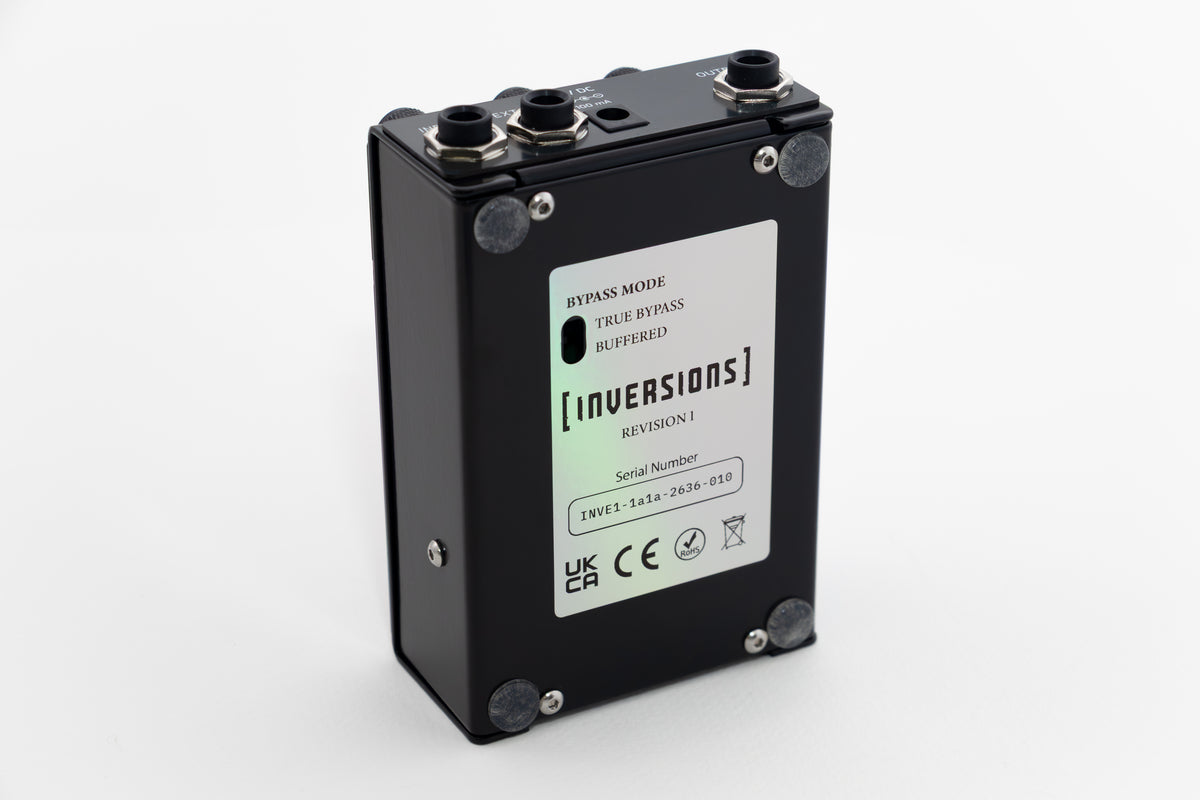
For flexible integration into different rigs, the pedal also supports both true bypass and buffered bypass, selectable using a dedicated switch on the underside of the enclosure.
Features
- 3-stage CMOS distortion circuit
- Tone control circuit with two modes
- Switchable true bypass or buffered bypass circuitry
- Soft-touch footswitches that persist state, even when disconnected from power
- External control input for operating the pedal with a controller / channel switcher
- Solid steel construction with durable powder coating.


Video coming soon...
Product Details - Inversions
Controls
- Volume - Controls the output signal amplitude.
- Tone - Adjusts the tonestack / low-pass filter, setting the balance of treble and bass frequencies.
- Gain - Master gain knob.
- Mode Switch - Switches between two tone control circuits.
- Active Footswitch - Enables or bypasses the pedal entirely.
- Bypass Mode (bottom of the pedal) - Sets the operation of the pedal when in bypass mode. Choose between true bypass or buffered bypass.
Details
Inversions maintains the same circuit topology as the original Big Muff, but uses CMOS 4049 inverter chips as its primary building blocks, as opposed to NPN transistors (or op amps in the Op-Amp Muff). The inverters impart their own unique sound and distort very differently from transistors, producing a smoother, thicker distortion that is fuller and less fuzzy than the original.
The original pedals had a very scooped-sounding tone stack, removing a lot of the mid-frequency content from the output signal. We wanted to give players the choice between a slightly more refined version of the original tone control and a more straightforward low-pass filter, similar to what is found on a RAT.
Note: the two modes do have a difference in output volume, so when toggling between them, you will need to adjust the volume knob as well to maintain the same loudness.
Choose your bypass operation by adjusting the slide switch on the bottom of the pedal. Use a small flathead screwdriver or a toothpick to carefully push the switch up or down.
In true bypass mode, the circuit is disconnected from the signal path when the pedal is bypassed. If power is disconnected from the pedal, the signal will still flow directly from input to output. This has its benefits when it comes to maintaining signal integrity and minimizing issues on large pedalboards, but it comes at the expense of noisier switching operation, where a faint "pop" sound can be heard when the pedal is engaged or bypassed.
Using a buffered bypass method means this pop is almost completely eliminated, as no physical contacts are being engaged or disconnected. A buffer in the signal chain can also be beneficial in certain scenarios, as it counteracts treble roll-off when using long instrument leads and provides a stronger signal for other pedals downstream.
We offer you the choice of either method so that you can integrate the pedal into your system in the best possible way.
The pedal can be controlled using an external switch connected via a 1/4" TRS connector. Both footswitches can be toggled using the external switching system.
Technical Specs
- Power Requirement: 9V DC, 100mA
- Power connector: 2.1mm center-negative barrel jack
-
External Switching: 1/4" TRS connection. "Short to ground" operation.
- Tip: Active Footswitch
- Ring: Not used
- Sleeve: Ground
- Input Impedance: >1MΩ
- Output Impedance: 1kΩ
- Bypass circuit: Buffered bypass or True Bypass
-
Footswitch mechanism: Momentary, soft-touch, relay control.
- Footswitch state is stored and recalled even when the pedal is disconnected from power.
- Dimensions: 83mm (W) 125mm (D) 55mm (H)
- Dimensions (with packaging): 126mm (W) 146mm (L) 67mm (H)